
District Projects
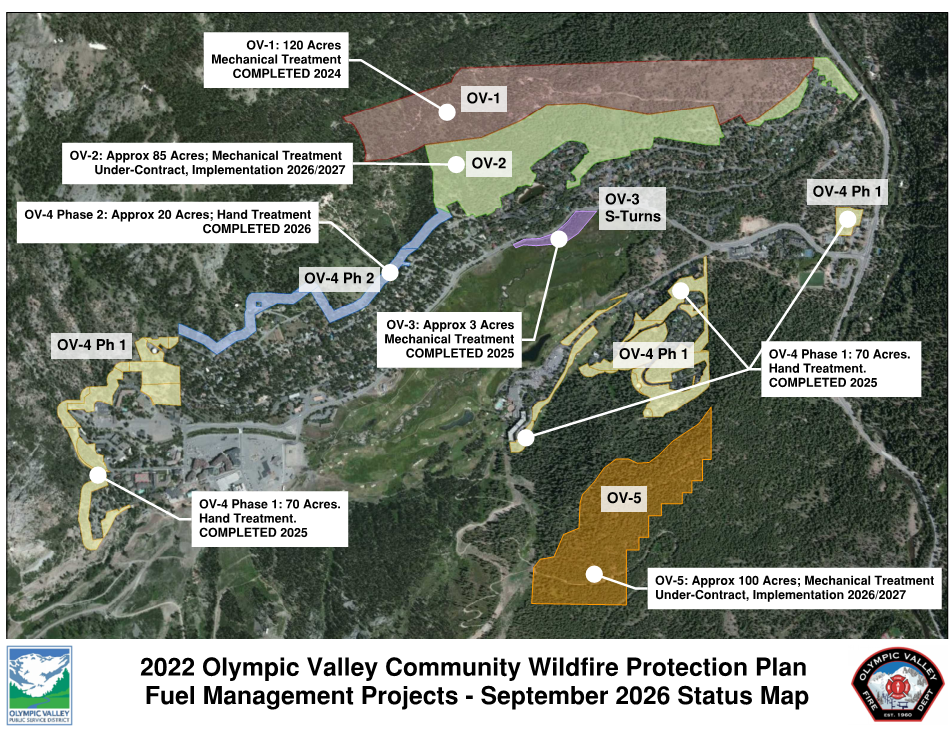
In 2022, the District approved the Olympic Valley Community Wildfire Protection Plan (CWPP). The plan identifies and prioritizes the fuels reduction and wildfire prevention strategy within Olympic Valley Fire Department’s service area. Five major fuels reduction projects were prioritized:
OV-1: North Ridge Fuel Reduction – COMPLETE
Funded by a grant from CAL FIRE (Project Tracking Number: 21-FP-NEU-0209), this shaded fuel break covers 120 acres on the ridgeline north of the community. The fuel break was completed using primarily mechanical thinning and mastication methods and was completed in July, 2024. This break will significantly reduce flame length, intensity, rate of spread and potential duration of wildfire in the area. For more information about OV-1 please look at our July 2023 Board Exhibit F-3, August 2022 Board Exhibit F-2, and October 2022 Board Exhibit F-3.
Informational Resources:
Slideshow Presented August 14th, 2023
August 14th, 2023 Community Meeting Recording (note- recording started about 5 minutes into meeting)
USFS – Fuels Project Saves Homes (slideshow page #9 video)
The Olympic Valley Fuel Reduction Project is part of California Climate Investments, a statewide program that puts billions of Cap-and-Trade dollars to work reducing GHG emissions, strengthening the economy, and improving public health and the environment- particularly in disadvantaged communities. The Cap-and-Trade program also creates a financial incentive for industries to invest in clean technologies and develop innovative ways to reduce pollution. California Climate Investments projects include affordable housing, renewable energy, public transportation, zero-emission vehicles, environmental restoration, more sustainable agriculture, recycling, and much more. At least 35 percent of these investments are located within and benefiting residents of disadvantaged communities, low-income communities, and low-income households across California. For more information, visit the California Climate Investments website at: www.caclimateinvestments.ca.gov
OV-2: North Slope Fuels Reduction – Under Contract, Implementation Planned for 2026-2027
OV-2 is an 84-acre hazardous fuel reduction project on privately owned land in Olympic Valley, situated between the OV-4 community buffer and the OV-1 north ridge thinning project. Funded through a grant from the Truckee Tahoe Airport District, the project follows a similar prescription to OV-1 with mechanical cutting, processing, and forwarding to create a shaded fuel break with 18–35 feet of tree spacing, followed by mastication to remove approximately 75% of surface fuels. Access will be via the east end of Winding Creek Road and Tiger Tail Road. Design, permitting, and contract bid and award were completed in the fall of 2026, with implementation scheduled to be completed by Cross Check Services by the end of 2027.
Click this link for the full Bid Prospectus.
OV-3: Roadside Wildfire Safety – COMPLETE
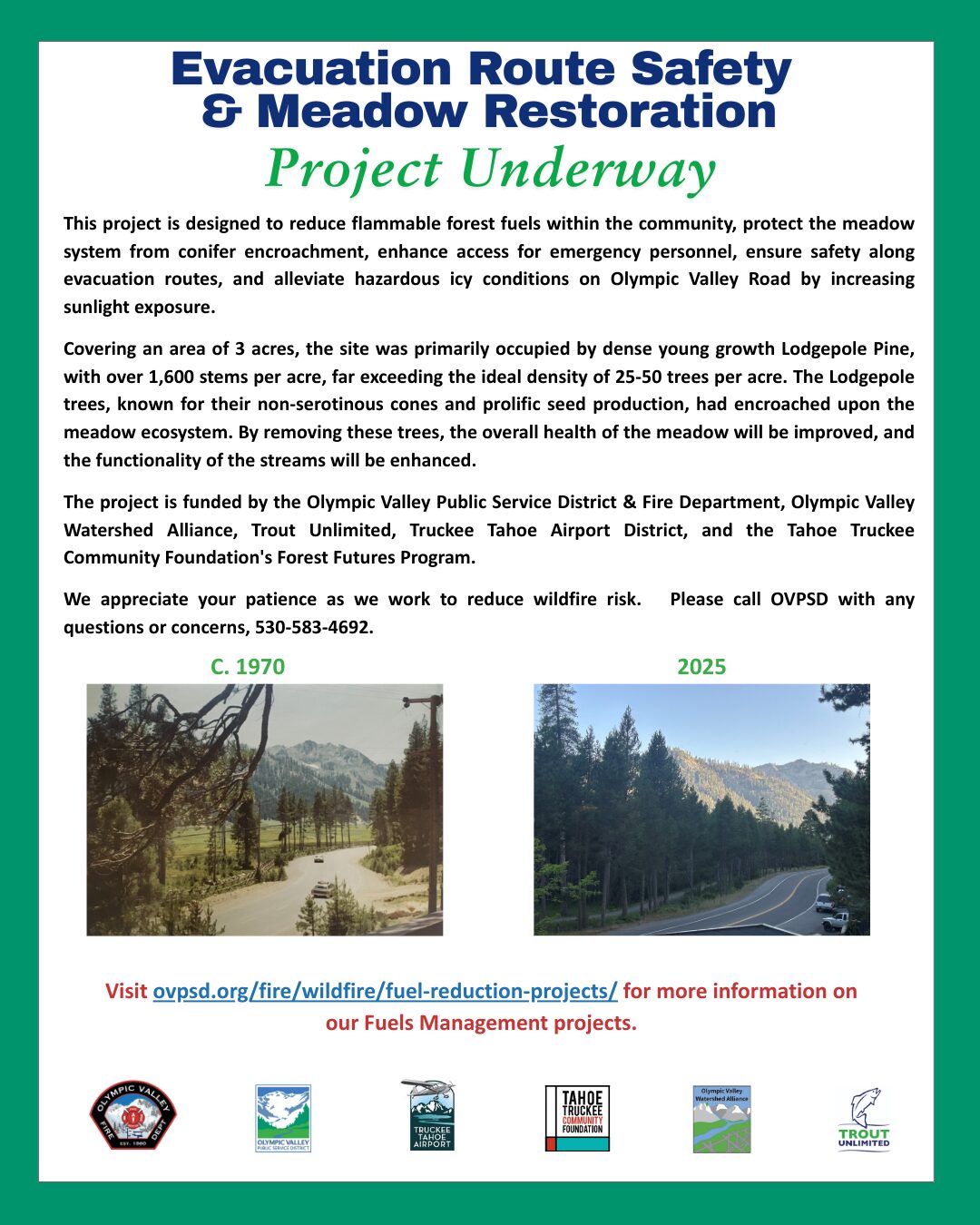
In the event of a fire emergency, movement into and out of the valley is of paramount importance. Clear and safe roads are essential for ingress of fire personnel and egress of evacuees. Currently, there is one entrance and exit into the valley, a potential traffic bottleneck. For efficient travel, roadside hazard reduction along Olympic Valley Road and Resort Road is needed to reduce the risk of trees or other objects (signs, structures, etc.) falling into the roadway if they catch fire. The Evacuation Route Roadside Hazard Fuels Reduction Project (OV-3/S-Turns) focused on a 2.7 acre stand of lodge pole pine on the south side of Olympic Valley Road in the Washeshu Creek meadow. The Project was started in December 2021 by the Friends of Squaw Creek using funding from Trout Unlimited. Phase two of the project was funded through a grant from the Tahoe Truckee Community Foundation Forest Futures Program and Truckee Tahoe Airport District. For more information about OV-3 please look at some of our past Board Reports including: September 2022 Board Exhibit F-6; June 2022 Board Exhibit F-9; and August 2024, F-6 and F-7.
OV-4: Community Wildfire Buffer Project – COMPLETE
A fuels reduction project surrounding the perimeter of homes, buildings, and other structures in the valley. In the event of an encroaching fire, this shaded fuel break provides the community an additional layer of safety on top of individual lot maintenance. This buffer was created with hand cutting and chipping. In 2023 the District received a grant from the Tahoe Truckee Community Foundation (TTCF) and the California Department of Forestry and Fire Protection’s Wildfire Resilience Program (CAL FIRE) to complete layout, design, and CEQA compliance for a minimum 150-foot wide fuel break surrounding the perimeter of residential properties, buildings, and other structures in the valley on private parcels greater than 3 acres totaling approximately 100-acres. The Truckee Tahoe Airport District generously provided $400,000 and TTCF/CAL FIRE provided $350,000 of implementation funding for the project. To learn more about the project please review past Board Reports including the July, 2023 Board Exhibit F-2, the June, 2023 Board Exhibit F-15, and August, 2024 F-5.
Informational Resources:
Slideshow Presented September 28th, 2023
September 28th, 2023 Community Meeting Recording
OV-5: South Ridge Fuel Reduction – Under Contract, Implementation Planned for 2026-2027
OV-5 is a 100-acre fuel reduction project along the south ridge of Olympic Valley, on the ridgeline between Olympic Valley and Alpine Meadows. Located entirely on private property within the Very High Fire Hazard Severity Zone, the project will use mechanical thinning and mastication to reduce fuel loading and improve forest conditions — creating a shaded fuel break that reduces flame length, fire intensity, and rate of spread. The project is directly adjacent to the USFS Alpine Meadows Hazardous Fuel Reduction Project to the south. Design, permitting, and contract bid and award were completed in the Spring of 2026, with implementation scheduled to be completed by Cross Check Services by the end of 2027. Funding for this project is provided by the Truckee Tahoe Airport District and the California Department of Forestry and Fire Protection’s (CAL FIRE) Wildfire Prevention Grants Program as part of the California Climate Investments Program.
Click HERE for the full Bid Prospectus
Click HERE for the Project Information Sheet
The District has been awarded almost $2.5M in grant funding as of April, 2026. These funds are dedicated to the planning and implementation of fuels management projects as summarized below:
| Project | Grantor | Date Awarded | Funding |
|---|---|---|---|
| Community Wildfire Protection Plan (CWPP) | CAL FIRE | Oct. 2021 | $31,898 |
| North Ridge – OV-1 (120 acres) | CAL FIRE | Nov. 2022 | $539,888 |
| Evacuation Corridor– OV-3 (3 acres) | Tahoe Truckee Community Foundation (TTCF) | July 2022 | $50,000 |
| Trout Unlimited / Friends of Squaw Creek | Nov. 2021 | $19,000 | |
| Community Buffer – OV-4 (90 acres) | TTCF / CAL FIRE | July 2023 | $45,125 |
| Truckee Tahoe Airport District | April 2024 | $400,000 | |
| TTCF / CAL FIRE | August 2024 | $350,000 | |
| North Slope (OV-2, 84 Acres) + OV-3 Traffic Control | Truckee Tahoe Airport District | April 2025 | $650,000 |
| South Ridge (OV-5, 100 Acres) | Truckee Tahoe Airport District | April 2026 | $400,000 |
Fuels Management on National Forest Lands Adjacent to Olympic Valley:
Five Creeks Project
The Five Creeks Project promises to be a major fuels management initiative to provide protection for the Olympic Valley community. The project area aligns with the Truckee River and the State Route 89 corridor, south of Truckee and north of the Olympic Valley, approximately five miles northwest of Lake Tahoe. More information on the project can be found on the Middle Truckee River Forest Partnership page, here, and USFS website, here
Alpine Meadows and Olympic Valley Fire Protection Project
This approximately 700-acre project is planned to reduce fuel loading and promote forest health on the Tahoe National Forest surrounding the communities of Alpine Meadows and Olympic Valley. The National Forest Foundation (NFF) entered into a grant agreement with the Sierra Nevada Conservancy which will provide implementation funding for the project. More information on the project can be found on the NFF website, here, and USFS website, here.